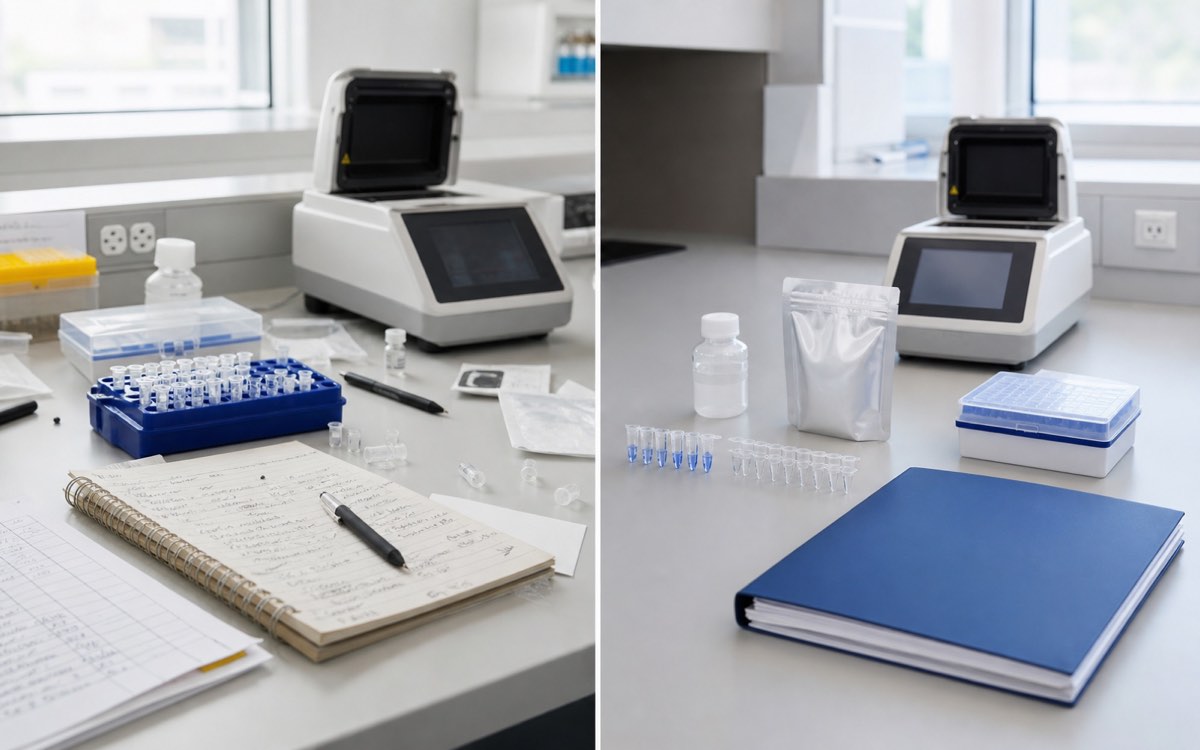
The gap between a working bench PCR protocol and repeat reagent supply is usually not one dramatic technical failure. It is a collection of small assumptions: an unspecified tube, an operator's preferred mixing step, an instrument default, an oligonucleotide substitution, a control concentration, or an acceptance decision that was never written down.
Gap 1: the protocol omits tacit knowledge
Experienced operators adjust mixing, timing, pipetting, plate handling, and analysis without noticing that those choices are not in the method. Observe the current workflow and capture steps that influence results before transfer.
Gap 2: materials are named but not specified
A trade name alone may not define grade, formulation, concentration, lot handling, purification, modification, or acceptable alternative. Create a bill of materials with critical attributes and identify which substitutions require assessment.
Gap 3: instrument and analysis settings are incomplete
Thermal conditions may be documented while optical acquisition, channel assignments, baseline, threshold, color compensation, software version, or export method remains implicit. These settings affect what another team sees and how results are compared.
Gap 4: acceptance criteria are retrospective
If a team decides whether material is good only after looking at the result, evaluation becomes inconsistent. Define the comparison, controls, relevant observations, reviewer, and decision route before the evaluation lot is tested.
Gap 5: packaging is treated as decoration
Tube, strip, plate, seal, pouch, desiccant, label, storage, shipment, and reactions per package affect the material and laboratory workflow. Packaging should be part of the technical product definition, especially for lyophilized reagents.
Gap 6: repeat supply has no owner
A successful evaluation can still stall when there is no approved specification, forecast, reorder point, lead-time assumption, change process, or owner for investigation and communication. Capture continuity requirements before the project leaves development.
Close gaps in sequence
Freeze the current baseline, identify critical omissions, run focused work, configure evaluation material, review against predefined criteria, and only then move into pilot and repeat planning. This sequence keeps scientific learning visible and manufacturing decisions traceable.