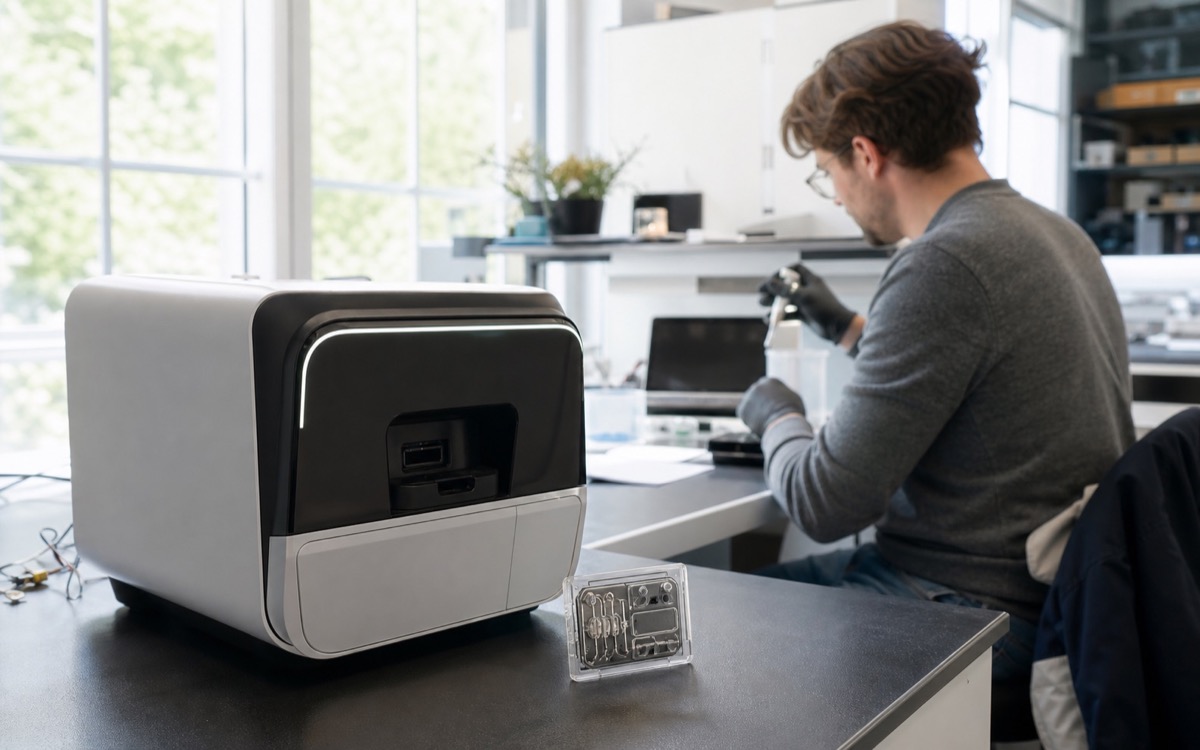
The diagnostics landscape is shifting. What once required centralized laboratories, expensive equipment, and days of waiting is now moving to the point of care: clinics, pharmacies, homes, and even remote field stations.
Point-of-care diagnostics (POCD) represents one of the most significant transformations in modern healthcare. By bringing testing closer to the patient, we reduce turnaround times from days to minutes, enabling faster clinical decisions and better outcomes.
The convergence of AI and biotechnology
The real inflection point comes when artificial intelligence meets biological sensing. Machine learning algorithms can now interpret complex biomarker patterns in real time, turning raw assay data into actionable clinical insights without the need for a trained laboratory technician.
This convergence enables a new class of diagnostic devices that are not only portable but genuinely intelligent. They learn from each test, improve their accuracy over time, and can flag anomalies that human operators might miss.
Miniaturization and microfluidics
Advances in microfluidics have made it possible to conduct complex multi-step assays on a chip smaller than a credit card. Sample preparation, amplification, and detection can happen in a single disposable cartridge.
These microfluidic platforms, combined with advances in biosensor technology, are enabling multiplexed testing, allowing screening for multiple conditions from a single sample in a single run.
Connectivity and data ecosystems
Modern POCD devices are no longer standalone instruments. They are connected nodes in a larger health data ecosystem. Results are transmitted securely to electronic health records, surveillance systems, and clinical decision support platforms.
This connectivity transforms diagnostics from a one-time event into a continuous data stream, enabling population-level insights and real-time epidemic monitoring.
Challenges ahead
Despite the promise, significant challenges remain. Regulatory frameworks are still catching up with the pace of innovation. Quality assurance for decentralized testing requires new approaches. And ensuring equitable access, particularly in low-resource settings, demands thoughtful design and sustainable business models.
The path forward
The future of point-of-care diagnostics is not just about making devices smaller or faster. It is about creating intelligent, connected, and accessible testing ecosystems that fundamentally change how healthcare is delivered.
At Dxplora, we work with innovators who are building this future, providing the validation infrastructure, intelligent tools, and global partnerships needed to turn promising technologies into real-world impact.