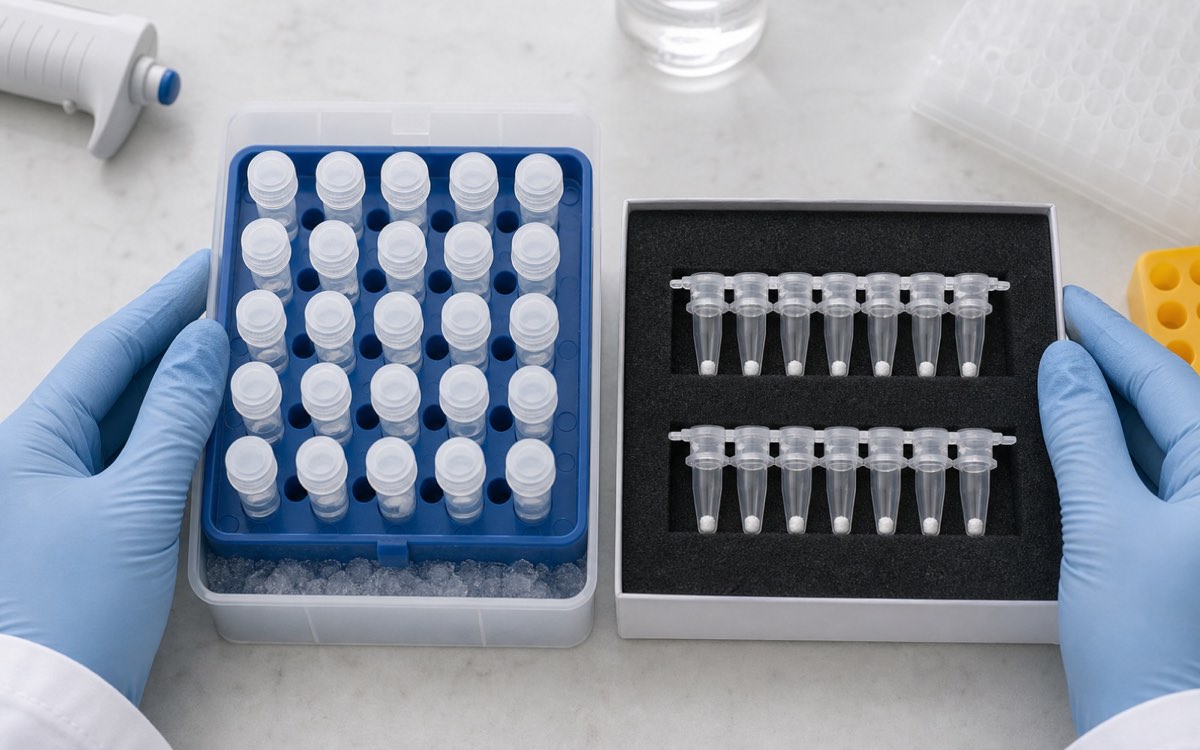
Liquid and lyophilized PCR reagents can use the same underlying assay design, but they create different development, handling, packaging, and supply requirements. Liquid is often the practical first format for technical evaluation. Lyophilization becomes valuable when simplified setup, controlled dispensing, shipping, or stability objectives justify the extra formulation work.
When liquid PCR reagents make sense
Liquid reagents preserve a familiar bench workflow and can reduce the number of variables introduced during early development. They are useful when the priority is rapid comparison with the originating method, flexible adjustment of concentrations, or a limited evaluation quantity. They may require frozen or refrigerated storage depending on chemistry and study results.
When lyophilized PCR reagents make sense
A dry format can combine selected reaction components in a tube, strip, plate, or cartridge presentation. This can reduce pipetting steps and make the finished configuration easier to distribute or standardize. Achieving that benefit requires compatible excipients, controlled freezing and drying, defined reconstitution, moisture-sensitive packaging, and evidence supporting the intended storage conditions.
Compare development effort
Liquid configuration usually follows core assay optimization. Lyophilization adds another development layer because drying can change enzyme activity, oligonucleotide behavior, pellet structure, reconstitution, and amplification performance. The dry formulation should therefore be compared against a known liquid baseline rather than optimized in isolation.
Compare workflow and packaging
A liquid kit may separate master mix, primer-probe mix, controls, and water. A lyophilized presentation may place some or most reaction components in the final vessel. The final choice affects operator steps, contamination opportunities, dead volume, labeling, pouch material, desiccant strategy, and package size.
Compare supply planning
Liquid and dry formats both need controlled specifications, release criteria, and lot documentation. Lyophilized products may introduce longer manufacturing cycles and specialized capacity, while liquid products may create cold-chain and freeze-thaw constraints. Demand pattern and reorder lead time matter as much as theoretical shelf life.
A practical decision sequence
Start with the intended workflow and business constraint, not with a preferred technology. Define storage and shipping objectives, user steps, reaction vessel, instrument compatibility, quantity range, and acceptable development effort. Then evaluate whether liquid, lyophilized, or a phased liquid-to-dry pathway best addresses those requirements.