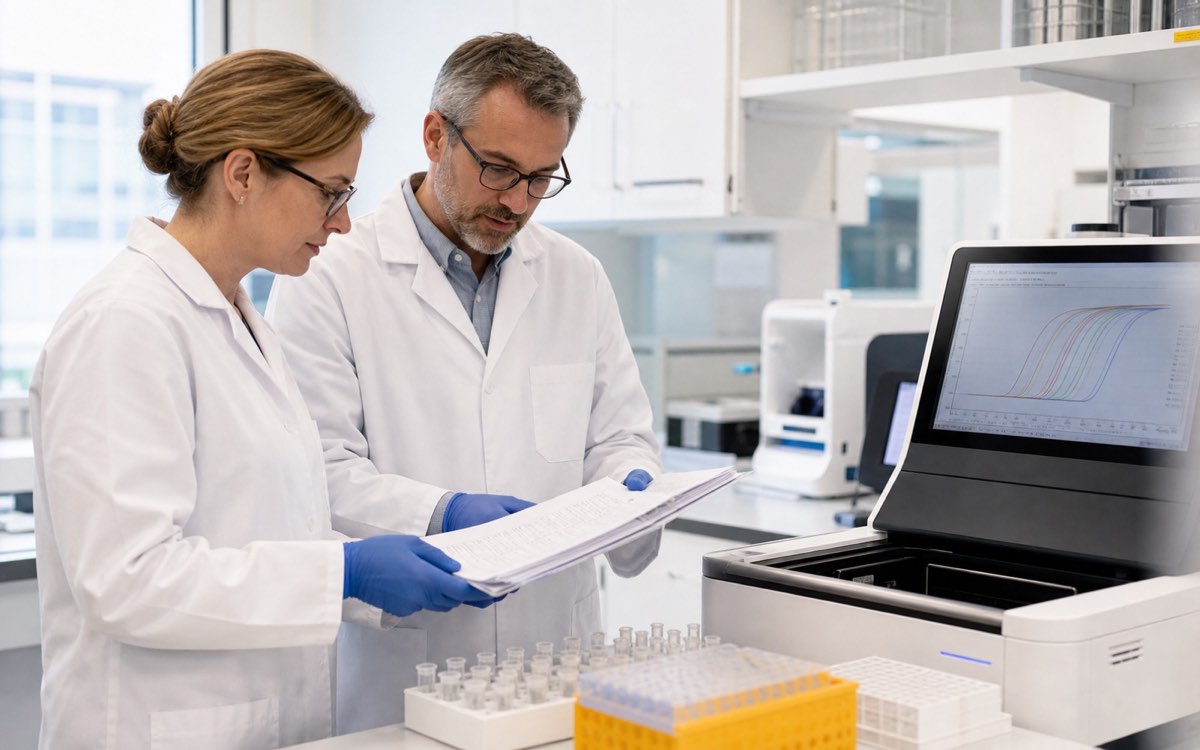
PCR assay technology transfer is the controlled handoff of a working assay from the originating team to a development or manufacturing partner. A successful transfer gives the receiving team enough information to reproduce the defined reagent format, evaluate it against agreed criteria, and plan repeat production without depending on unwritten bench knowledge.
When is a PCR assay ready for transfer?
An assay does not need to be perfect before transfer, but its current state must be understandable. The originating team should be able to identify the target, workflow, instrument, reaction volume, controls, known failure modes, and the performance questions that remain open. If several variables are changing at once, a short optimization phase usually belongs before formal transfer.
The 12 inputs a receiving partner needs
A practical transfer package covers: intended research or laboratory use; target and analyte definition; primer and probe sequences and specifications; reagent bill of materials; master-mix or enzyme requirements; reaction volume; cycling and optical settings; sample matrix and extraction workflow; positive, negative, and internal controls; representative raw and analyzed data; current acceptance criteria; and the desired liquid or lyophilized packaging format.
Document the technical baseline
The current baseline should include more than a polished protocol. Record reagent suppliers and grades, oligonucleotide purification, working concentrations, mixing order, hold times, plate or tube type, sealing method, instrument software settings, threshold approach, and any operator-dependent steps. These details reveal which parts of the method are robust and which still rely on local practice.
Define evaluation criteria before material is produced
A receiving partner needs to know how the first material will be judged. Criteria may address expected curve shape, control behavior, replicate consistency, background signal, comparison to the originating preparation, and practical handling. These are project-specific evaluation criteria, not universal clinical performance specifications.
Move in controlled stages
A sensible pathway is baseline review, transfer-gap assessment, evaluation lot, targeted refinement, pilot lot, and repeat-supply planning. Each stage should answer a defined question. Jumping directly from a bench mix to a large quantity can preserve hidden variability and make later investigations harder.
Keep responsibilities clear
The development or manufacturing partner controls the work within its agreed scope and documents the produced material. The laboratory or assay owner defines intended use, establishes performance specifications, conducts the studies required for its setting, and determines whether the assay is suitable for implementation.