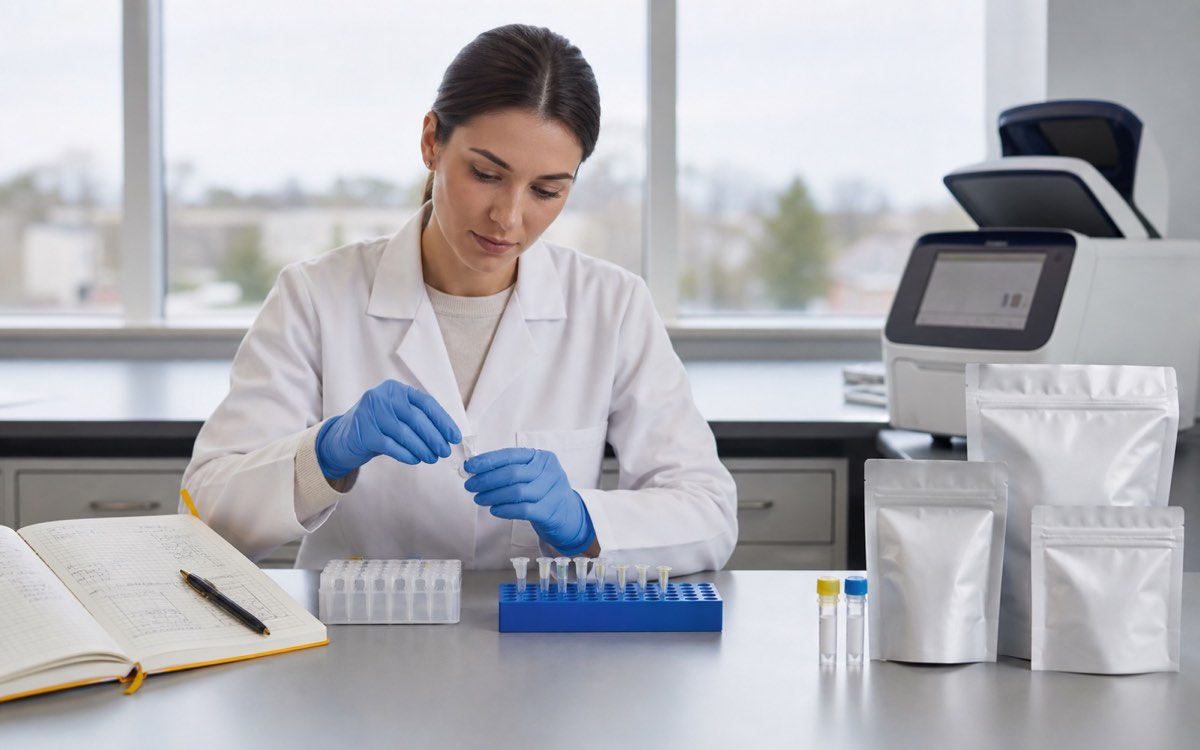
Custom PCR assay development can take several focused development cycles rather than one fixed number of weeks. A project that begins with functioning primers, representative data, a defined matrix, and a known instrument can move quickly into format evaluation. A project beginning only with a target concept needs additional design, feasibility, and optimization work.
Stage 1: define the project brief
The first stage aligns the target, analyte type, sample matrix, extraction workflow, PCR modality, instrument, reaction volume, optical channels, controls, and desired presentation. Ambiguity at intake tends to reappear later as repeated experiments or incompatible packaging decisions.
Stage 2: establish analytical feasibility
Feasibility work asks whether the selected oligonucleotides and chemistry produce interpretable amplification under the intended workflow. For an existing assay, this stage may be a baseline confirmation. For a new assay, it may include design review, screening, and comparison of candidate conditions.
Stage 3: optimize the controlled variables
Optimization should focus on variables that materially affect the intended format: primer and probe concentrations, enzyme and buffer system, thermal profile, reaction volume, control strategy, and matrix compatibility. Multiplex assays also require balancing so one target does not dominate the reaction or optical interpretation.
Stage 4: configure evaluation material
Once a defensible baseline exists, the chemistry can be configured into the chosen liquid or dry format. The evaluation lot is intentionally limited. Its purpose is to compare the produced material with the originating preparation and expose handling, packaging, or process effects before larger quantities are made.
Stage 5: pilot and repeat-supply planning
Pilot work tests whether the defined process and packaging can be repeated at a more representative scale. Repeat-supply planning then addresses specifications, incoming materials, release checks, packaging configuration, demand range, and change communication.
What shortens the timeline?
Fast projects have a single decision owner, accessible raw data, agreed acceptance criteria, representative materials, and prompt review of each cycle. The biggest delays usually come from changing intended workflows, waiting for samples or controls, and trying to solve design, multiplexing, lyophilization, and scale-up simultaneously.