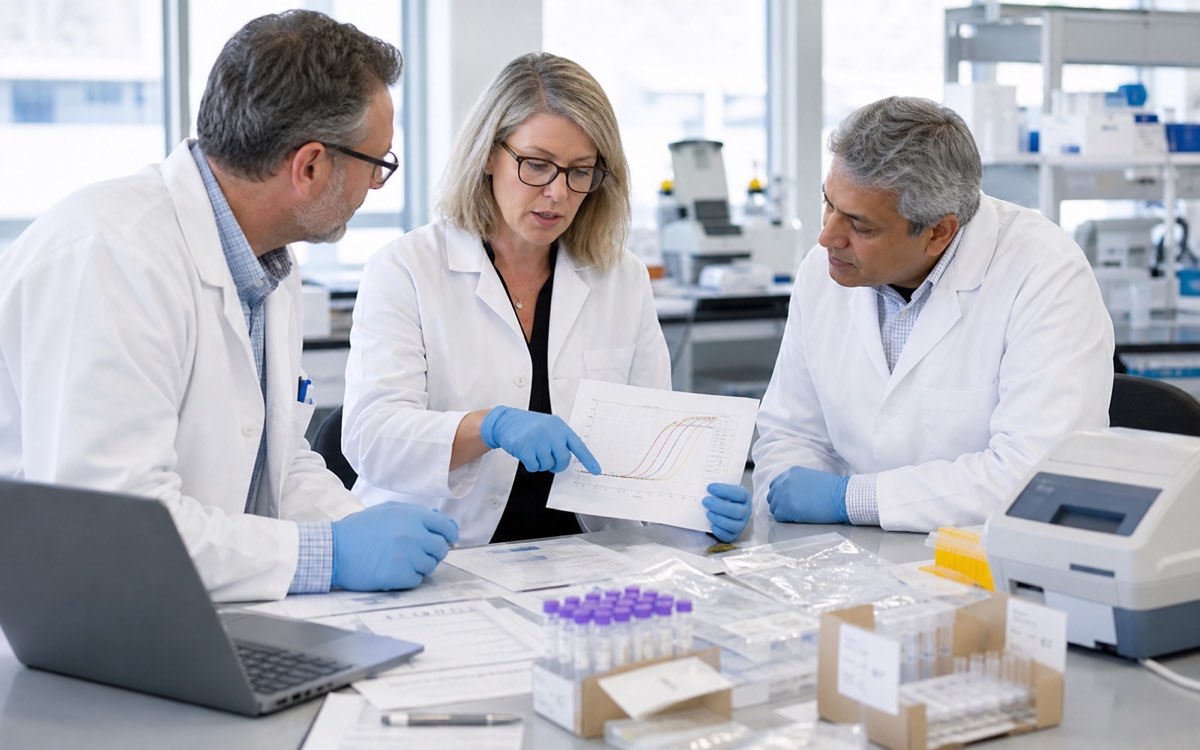
A PCR development and manufacturing partner should be evaluated on more than a capabilities list. The right partner understands the current assay stage, explains what information is missing, proposes a controlled sequence of work, documents material and decisions, and shows how a successful evaluation could move toward repeat supply.
Confirm the exact technical scope
Ask whether the partner supports primer-probe review, chemistry selection, multiplex balancing, controls, liquid configuration, lyophilization, filling, packaging, evaluation quantities, pilot production, and repeat manufacturing. Do not assume that the word development includes every one of these activities.
Understand where work is performed
Some organizations perform all work in one facility; others use qualified specialist partners. Either model can work when responsibilities, material movement, records, communication, and quality oversight are explicit. The important question is not whether a network exists but whether it is controlled and transparent.
Review the proposed development logic
A strong proposal identifies inputs, assumptions, experiments, outputs, review points, and what happens when criteria are not met. Be cautious when a proposal jumps directly to a large manufacturing quantity or treats an undefined assay as a fixed product.
Examine documentation and change handling
Discuss specifications, batch records, lot identifiers, release information, deviations, retained knowledge, raw data access, oligonucleotide changes, supplier substitutions, and communication before changes. Documentation should support continuity rather than appear only after a problem.
Test communication before committing
Technical projects need a named owner, review cadence, decision route, and realistic response expectations. Notice whether questions receive specific answers, whether limitations are stated, and whether the team distinguishes development data from claims the evidence cannot support.
Check the path beyond the first lot
An evaluation partner should be able to explain how the chosen materials, vessel, packaging, release approach, and forecast could transition into pilot and repeat production. That does not require a premature long-term commitment, but it prevents an attractive prototype from reaching another dead end.