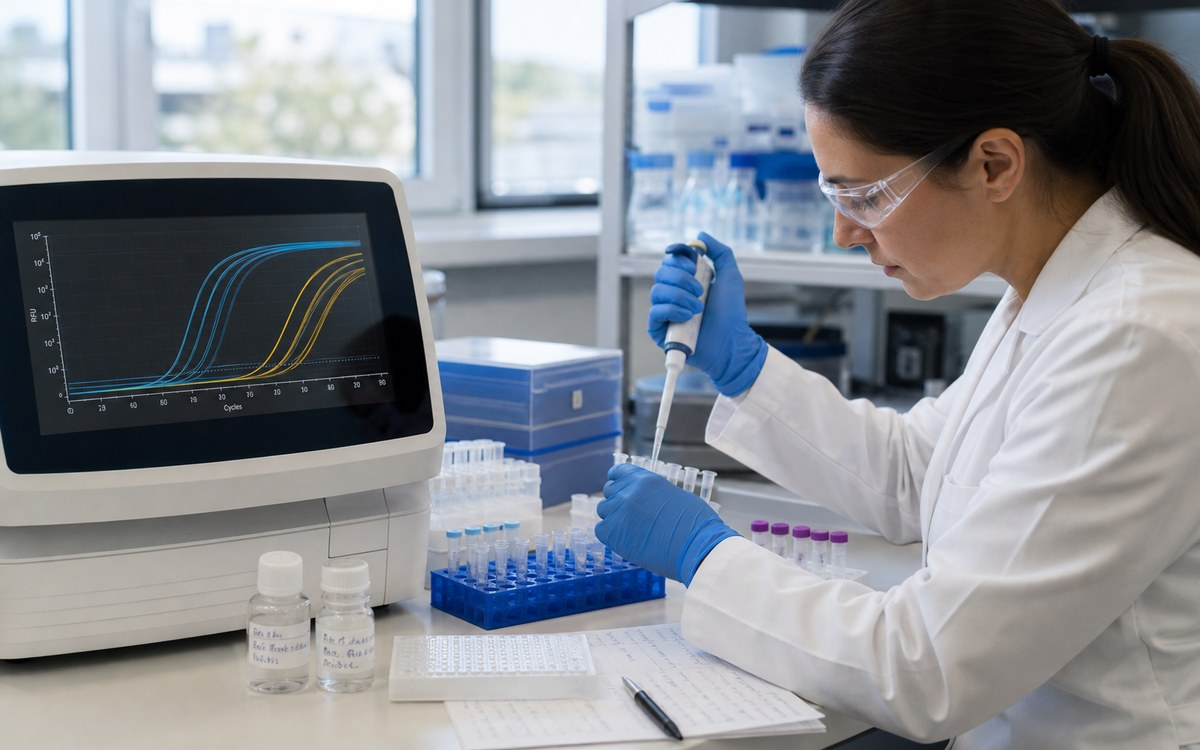
qPCR inhibition occurs when substances associated with the sample or workflow reduce reverse transcription, amplification, or fluorescence interpretation. Before technology transfer, the team should know how inhibition is detected, which matrices were challenged, what mitigation is allowed, and how an affected result is interpreted.
Map where inhibition can enter
Potential sources include collection devices, anticoagulants, transport media, tissue components, mucus, blood products, extraction reagents, wash carryover, high nucleic-acid background, and substances introduced during preparation. The relevant list depends on the claimed or research matrix and workflow.
Distinguish low target from reaction failure
A weak or absent target signal can reflect low analyte, degradation, extraction loss, inhibition, reagent failure, or instrument error. Controls should be placed so the workflow can distinguish among these possibilities. A positive control added directly to a clean reaction may demonstrate amplification chemistry but not the extraction or sample background.
Measure inhibition with a defined comparison
Common approaches compare an internal or exogenous control in the sample background with the same control in a suitable clean condition, assess a dilution series, or use matrix-spiked material. The expected shift and acceptance rule should be established for the assay rather than improvised after a run.
Select mitigation based on the source
Diluting the extract can reduce inhibitor concentration but also dilutes the target. Additional cleanup may improve purity but can lose nucleic acid. Extraction changes, input-volume adjustments, additives, or more tolerant chemistry may help in specific cases. Each intervention should be evaluated against target recovery and workflow practicality.
Protect multiplex and internal-control balance
An internal control must be present at a level that identifies relevant failure without consuming enough reagents to suppress a low-level target. In multiplex assays, inhibition and competition can appear similar, so singleplex and high-low target experiments remain useful during diagnosis.
Document the matrix claim carefully
Evidence from one specimen type, transport medium, extraction method, or eluate should not be generalized automatically to another. The technical file should state the matrices and interferents evaluated, their concentrations, control design, observed effects, mitigation, and remaining limitations.
Transfer an inhibition strategy, not just a protocol
The receiving partner needs representative inhibited and uninhibited data, control materials, reaction and extraction inputs, allowed mitigation steps, and acceptance criteria. Manufacturing can then assess whether reagent or process changes alter the established inhibition behavior.
Separate development evidence from laboratory claims
A development team may characterize selected matrices and extraction conditions to guide formulation and transfer. That evidence does not automatically establish performance for every specimen type, collection device, transport medium, or laboratory workflow. The receiving laboratory should understand exactly which conditions were studied, which were inferred, and which remain its responsibility to evaluate for the intended use.
Create an investigation sequence for unexpected shifts
When amplification changes, investigate in a fixed order: confirm controls and analysis settings, compare clean-template performance, review extraction and matrix changes, check reagent and instrument history, then test a documented mitigation. Changing dilution, additives, cycling, and thresholds at the same time may recover a result but destroys diagnostic value. A controlled sequence preserves evidence and helps determine whether the root cause belongs to chemistry, sample preparation, equipment, or interpretation.