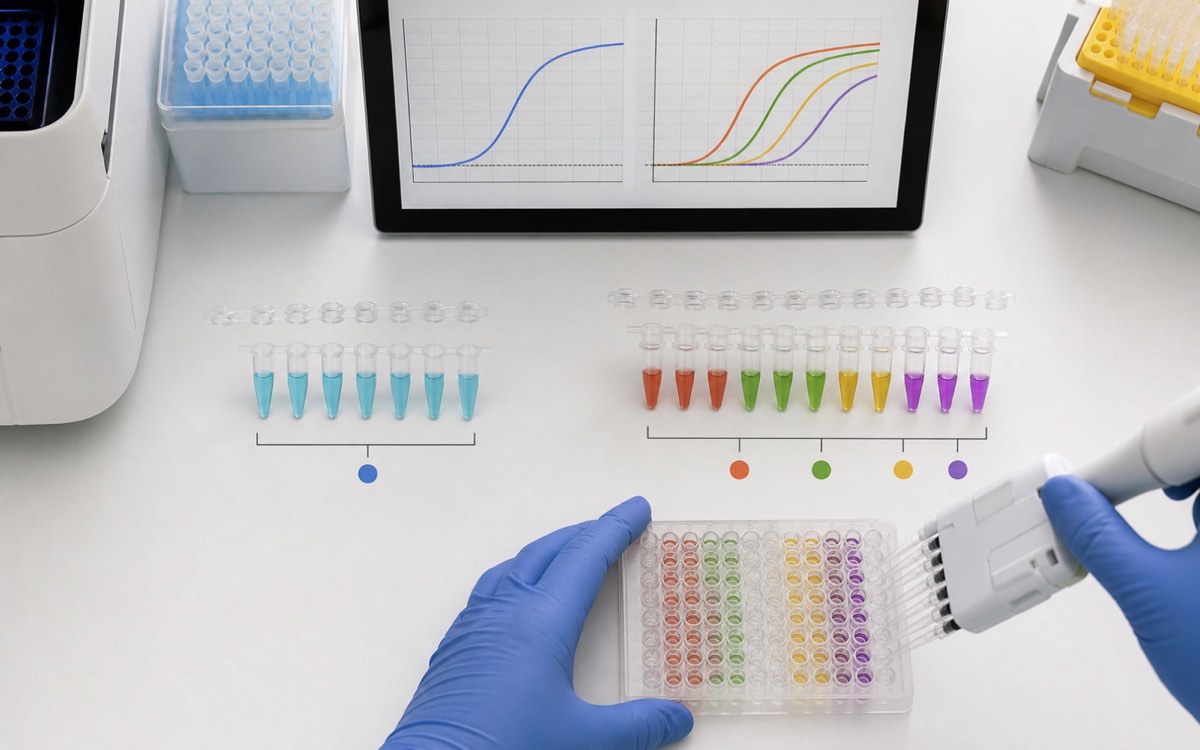
Singleplex qPCR measures one target reaction at a time, while multiplex qPCR combines multiple targets or controls in the same vessel. Multiplexing can reduce sample volume and setup burden, but it changes the assay from a collection of independent reactions into an interacting system that requires additional design and manufacturing control.
Why start with singleplex performance?
Individual reactions reveal whether each primer-probe set produces suitable amplification, background, specificity, and control behavior under the selected chemistry. This baseline makes it possible to recognize what changes when targets are combined.
Multiplex reactions create competition
Targets may compete for enzyme, nucleotides, primers, probes, and reaction capacity. A strong target can suppress a weaker one, particularly near the edge of the evaluated range. Concentrations often need rebalancing after individual feasibility is established.
Optical channels constrain panel design
Instrument channels, dye compatibility, spectral overlap, color compensation, and reference requirements affect which targets can be combined. The instrument model and analysis software should be identified early rather than treated as a later implementation detail.
Controls consume reaction space too
An internal control can reveal extraction or inhibition issues, but it also participates in the reaction. Its target, concentration, channel, and expected behavior should be selected so it provides information without unnecessarily reducing target performance.
Manufacturing complexity increases
A multiplex mix contains more oligonucleotides and potentially tighter concentration relationships. Supplier specifications, calculations, mixing order, homogeneity, fill process, and release checks should preserve that balance. A small concentration error that is invisible in singleplex may affect panel behavior.
Choose complexity for a workflow reason
Multiplexing is valuable when it meaningfully reduces sample use, setup, instrument positions, or turnaround within the intended workflow. It should not be added only to make a panel look more advanced. A smaller, well-controlled multiplex can be more useful than an overloaded reaction.